
Learn Quran With Tajweed Online: Recite the Way It Was Revealed
Here is something most new learners discover only after years of reading. They can read the Arabic words on the page, yet the recitation still sounds flat, rushed, and somehow not quite right. The letters are there. The music is missing. That gap is exactly what Tajweed fills. When you learn Quran with Tajweed online, you stop merely decoding letters and start reciting the way the Quran was actually revealed to the Prophet Muhammad, peace be upon him. Each letter finds its correct point of articulation. Each rule shapes the flow. The reading becomes accurate, measured, and beautiful. At Mariam Quran Tutor, a patient female teacher guides you through every rule one to one, over a simple video call. No crowded class. No skipped steps. In the sections below, you will understand what Tajweed really is, the specific rules you will master, and how the lessons work from your very first day.

What is Tajweed, and why does it matter so much?
Tajweed is the set of rules that governs how each Arabic letter and word of the Quran should be pronounced, so that recitation is correct, clear, and faithful to how it was revealed. The word itself means to improve or to do something well. To see why it matters, consider a small example. In Arabic, some letters that look similar to an English speaker are produced from completely different parts of the mouth and throat. Mispronounce one, and you can change the meaning of a word entirely. Tajweed protects the meaning by fixing the sound. There is a second reason, too, one that is harder to measure. Reciting with Tajweed slows you down. It turns reading into worship. Many of our students describe the moment their recitation first flowed correctly as the moment the Quran truly came alive for them. That is not a small thing, and it is the heart of why this skill is worth learning properly.
What does it mean to learn Quran with Tajweed online?
To learn Quran with Tajweed online means working through the rules of recitation in live, one-to-one video lessons, where a teacher hears every sound you make and corrects it in the moment. Tajweed is an oral skill, so this real-time correction is everything. Here is why the live format matters more for Tajweed than for almost any other subject. You cannot learn correct pronunciation from a textbook alone, because you cannot hear yourself the way a trained listener can. A teacher catches the subtle errors you are completely unaware of, the slightly wrong articulation point, the missing nasal sound, the elongation held for the wrong count. Lessons run over Zoom or Google Meet, usually 30 to 45 minutes, two or three times a week.
The Tajweed rules you will master
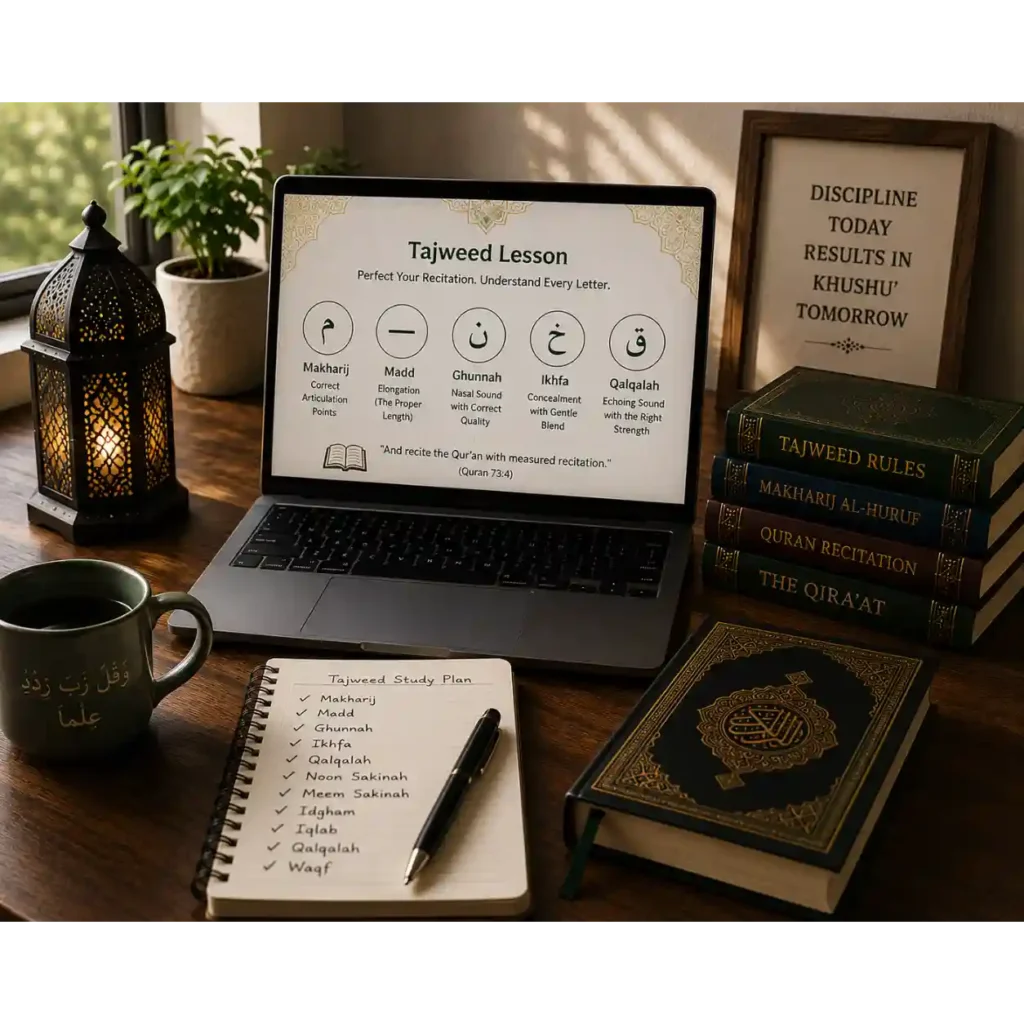
Tajweed is best learned as a connected system of rules, each building on the last, rather than as a list to memorise. Below is the path your lessons follow, with deeper guides on each rule linked for when you want to study further. Everything begins with the articulation points, known as the Makharij al-Huruf. These are the precise locations in the throat, tongue, and lips where each Arabic letter is produced. Get the Makharij right, and most other rules fall into place naturally. Alongside them sit the Sifaat, the characteristics that give each letter its weight and quality. From there, your teacher introduces the rules of the silent noon, covered in the Noon Sakin and Tanween guide. This single family of rules splits into four behaviours: clear pronunciation, merging, conversion, and concealment, the last of which is the well-known Ikhfa, where the sound is hidden softly into the next letter. The merging behaviour, Idgham, and the clear behaviour, Izhar, complete the set. The parallel rules for the silent meem are explained in the Meem Sakin guide. You will also learn Ghunnah, the gentle nasal sound that colours certain letters, and Madd, the controlled elongation of vowels that gives recitation its rhythm and length. Then comes Qalqalah, the slight echoing bounce on specific letters when they carry a sukoon. Finer points follow, including the handling of the hamza and the all-important stopping signs, or waqf, which tell you where to pause and where to continue so the meaning stays intact. Advanced students may later explore the different Qira’at, the recognised modes of recitation. If that list feels like a lot, do not worry. You never face it all at once. Each rule is introduced only when you are ready for it, and practised on real Quran passages until it becomes second nature.
How we teach Tajweed, one to one
Every student follows the same clear process: a free trial, a placement check, a steady weekly schedule, and constant real-time correction on actual Quran text. The method is patient and practical, never theoretical for its own sake. It starts with a free trial lesson, where the teacher listens to your current recitation and identifies exactly where to begin. A complete beginner may start from the Noorani Qaida to fix letters and sounds first, because Tajweed built on shaky letters never holds. A confident reader may jump straight into the noon and meem rules. From there, lessons follow a simple loop. The teacher explains a rule, demonstrates it aloud, listens as you apply it to a verse, and corrects gently until it is right. You then practise that rule across new passages in the days between lessons. This is how an abstract rule becomes a living habit, and it is the part that group classes, with their twenty or forty students, simply cannot deliver.
From Qaida to Tajweed to fluent recitation
Tajweed sits in the middle of a clear learning journey: first the letters, then the rules, then fluent recitation, and for some, memorisation. Knowing where you are on that path keeps motivation high. Most learners arrive after the Qaida stage, when they can read but cannot yet recite with rules. Tajweed is the bridge from mechanical reading to true recitation. Once the rules are secure, many students go on to begin Quran memorisation, and correct Tajweed makes Hifz far easier, because the sounds are already locked in correctly. Tajweed is also the essential foundation for anyone working toward a recognised Ijazah, which certifies that you can recite to a verified standard.
Who Tajweed lessons are for
Tajweed lessons suit children, adults, and sisters alike, with the starting point adjusted to each learner. No prior certificate is required, only a willingness to practise. Children fold Tajweed naturally into their kids’ classes as their reading matures, learning the rules without ever finding them daunting. Adults often come to Tajweed having read for years, ready at last to refine and correct their recitation, and our adult classes are built for exactly that. Sisters who prefer a female teacher will find that the full Tajweed path is available to them through our classes for sisters and girls, with no part of the curriculum held back.
How long does it take to learn Tajweed?
Most learners grasp the core rules within a few months of regular lessons, while polishing them to a fluent, automatic level takes longer and depends heavily on daily practice. There is no fixed finish line, because recitation always has room to deepen. A realistic picture looks like this. With two or three lessons a week and short daily practice, a motivated student usually has a working command of the main rules within three to six months. Reaching the smooth, effortless recitation you hear from skilled reciters is the work of years, not weeks, and that is true for everyone. Your free trial gives a far more personal estimate once a teacher has heard where you stand.
Where we teach
We are based in Luton, Bedfordshire, and teach Tajweed to students across the whole UK online. Learners in Luton, Bedford, and Dunstable often begin with us because we are local. Because the lessons are online, we teach just as effectively in Birmingham, Bradford, Manchester, Leicester, Slough, and across London, including Tower Hamlets, Newham, and Redbridge. The teaching standard stays the same wherever you log in. Trust block to insert before publishing. Add real teacher bios, photos, and any recognised Ijazah, since a verified chain of recitation matters greatly for a Tajweed page. Embed a 30 to 60 second recitation clip, which is the single strongest trust signal here. Add two or three named student testimonials with city and progress made, with permission. Avoid generic boasts.

Begin with a free trial
The first lesson is free, and there is no commitment to continue. It is the simplest way to hear, in your own recitation, exactly what Tajweed will improve. You can book a free trial lesson today, explore all our courses on the online Quran classes homepage, read more about Mariam Quran Tutor, or review the fees and pricing first. Tell us a little about your current reading, and we will reply with a suitable time, usually within a day.