
Online Quran Memorisation (Hifz) Course: A Realistic Path to Becoming a Hafiz
There is a myth that Hifz belongs only to a special kind of child, the rare one with a photographic memory who finishes at age ten. That myth quietly discourages thousands of ordinary people, adults included, who could absolutely memorise the Quran if only someone showed them the method and held them to it. The truth is far more encouraging. Hifz is not mainly about talent. It is about a sound method, honest revision, and steady consistency over time. An online Quran memorisation course gives you all three. A teacher assigns the right daily portion, listens as you recite it from memory, and, crucially, keeps your revision organised so the verses you learned last month do not quietly slip away. At Mariam Quran Tutor, a patient teacher guides this process one to one, which matters more for Hifz than for almost any other subject. In the sections that follow, I will explain exactly how memorisation works, where most people go wrong, and how to begin in a way you can actually sustain.
What is Hifz, and what does an online memorisation course involve?
Hifz means memorising the entire Quran by heart, and an online Quran memorisation course is a structured programme of daily memorisation and revision, guided live by a teacher over video. A person who completes it is called a hafiz, or hafiza for a woman. Let me set realistic expectations first, because honesty serves you better than hype. Memorising the whole Quran is a serious, multi-year commitment for most people. But the journey is made of very small daily steps, and each step is achievable. The course breaks the Quran into manageable portions, gives you a clear daily routine, and provides the one thing self-study cannot: a teacher who hears every word and catches every drift before it becomes a fixed mistake. Lessons run over Zoom or Google Meet, and Hifz students usually meet more often than other learners, because daily contact keeps the routine alive. Many memorise alongside refining their Tajweed, since accurate sounds make verses far easier to lock in correctly.

The method that actually works: new, recent, and old
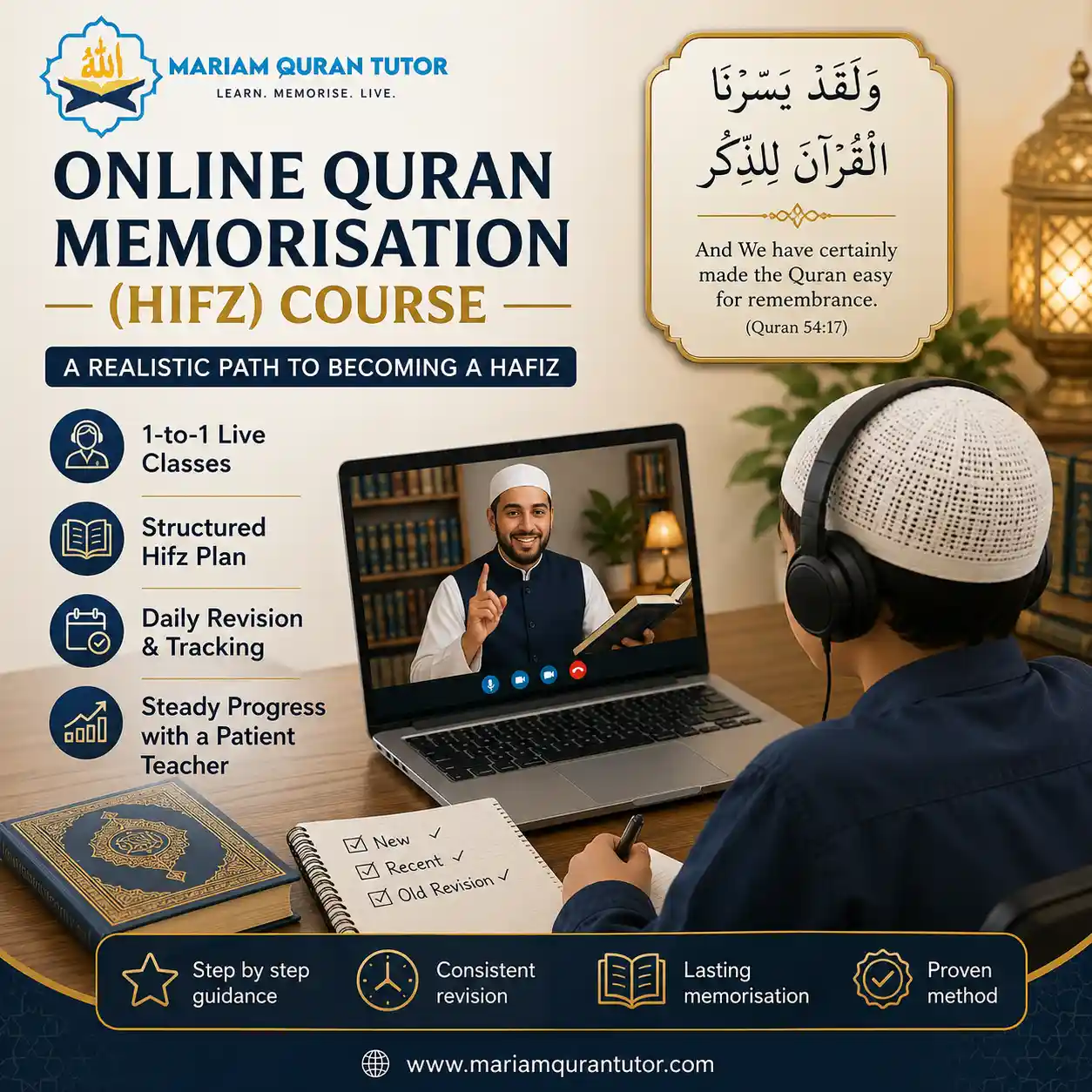
Effective Hifz rests on three daily portions worked together: the new lesson, the recent revision, and the old revision. This three-part system is the backbone of every serious memorisation programme, and understanding it is half the battle. Picture your memory as a garden with three beds. The first bed is the new lesson, traditionally called sabaq. This is the fresh portion you memorise today, usually just a few lines, recited until it is firm. The second bed is the recent revision, often called sabqi. These are the portions you memorised over the past several days and weeks, still fragile, needing daily attention so they set properly. The third bed is the old revision, the manzil. This is everything you have already memorised and consolidated, revised on a steady long rotation so it is never neglected. Skip this bed, and the oldest plants wither while you tend the new ones. That single mistake, neglecting old revision, is why so many would-be huffaz stall and give up. A good teacher manages all three beds for you, so you always know what to recite each day.
Why revision is the real secret
The hard part of Hifz is not memorising new verses. It is holding on to the ones you already know. Almost everyone underestimates this, and almost everyone who fails, fails here. I want to be very direct about this, because it will save you months of frustration. Memorising a new page feels like progress, so it is satisfying and people rush to do more of it. Revision feels like standing still, so people skimp on it. Then, weeks later, they discover that the early surahs have faded, and the discouragement is crushing. A structured course flips this instinct. It treats revision as the main event and new memorisation as the smaller, careful addition. Done this way, your memorised portion only ever grows, never quietly shrinks. Your teacher tracks exactly where you are in the revision cycle, which is something almost impossible to manage well on your own.
Why one-to-one online suits Hifz especially well
Hifz demands daily, individual listening, and a one-to-one online lesson delivers exactly that without the travel, in the comfort of your own home. This is not a subject that works in a crowd. In a group Hifz class, a child often recites to the teacher for only a couple of minutes, then waits while twenty others take their turn. The listening time, the part that actually corrects errors, is tiny. Online and one to one, the entire lesson is your recitation and your teacher’s correction. For a discipline built on daily, attentive listening, that difference is enormous. It is also why serious Hifz progress online is not a compromise but, for many families, an upgrade.
Where to begin
Most students begin Hifz with the short surahs of the final juz, the ones already used daily in prayer, then build outward from there. Starting with familiar verses creates early momentum and confidence. Before formal Hifz, your reading must be solid, which is why a strong foundation in the Noorani Qaida and Tajweed comes first. Trying to memorise verses you cannot yet read accurately simply locks in errors. Once reading is secure, beginning with Juz Amma, the last part of the Quran, lets a student memorise surahs they half-know already, which makes the first weeks feel achievable rather than dauntin.
How a Hifz lesson runs
Every student follows a clear daily rhythm: recite the new portion, present the recent revision, recite a section of the old revision, and receive the next day’s assignment. The structure is what makes the impossible feel routine. It begins with a free trial, where the teacher assesses your reading and sets a sensible starting portion. From there, each lesson follows the three-part pattern described above. The teacher listens, corrects, and notes precisely what you must revise before the next session. For children, parents receive a short update so they can support the daily practice at home, which is essential, since Hifz lives or dies by what happens between lessons.
Hifz for children and for adults
Both children and adults can succeed at Hifz, though the approach differs: children rely on repetition and routine, while adults can lean on understanding and discipline. Neither has a monopoly on success. Children often memorise quickly and benefit from the structure folded into their online Quran classes for kids, with plenty of encouragement and short, frequent sessions. Adults memorise differently. They may start slower, but their consistency and their grasp of meaning can carry them a long way, and many begin within their broader adult classes. I have seen adults memorise several juz over a couple of years simply by refusing to skip a single day. Refusing to skip is the whole secret.
How long does it take to memorise the Quran?
Full Hifz typically takes anywhere from two to five years or more, depending on age, daily time committed, and the strength of revision. There is no honest shortcut, and anyone promising one is best avoided. A child in an intensive routine may finish in a few years. An adult giving an hour a day will take longer, and that is completely fine. What truly determines the timeline is daily consistency and disciplined revision, not raw speed. For practical guidance, our cluster of memorisation guides covers this in depth, including how long memorising the Quran really takes, how to memorise faster, the best times of day to memorise, and realistic Hifz schedule templates.
Helpful tools and approaches
Beyond lessons, the right habits make a real difference. Our guides walk through memorising a page efficiently, practical Hifz tips for adults, and the most useful Quran memorisation apps for tracking revision. Used alongside a teacher who keeps you accountable, these tools support the routine rather than replace it.
For sisters who prefer a female teacher
Every lesson at Mariam Quran Tutor is taught by a female teacher, so sisters and girls can pursue full Hifz in a comfortable, modest setting. The complete memorisation path is open to them, with nothing held back, as explained on our classes for sisters and girls page.
Where we teach
We are based in Luton, Bedfordshire, and teach Hifz students across the whole UK online. Learners in Luton, Bedford, and Dunstable often begin with us because we are local. Because the lessons are online, we teach just as effectively in Birmingham, Bradford, Manchester, Leicester, Slough, and across London, including Tower Hamlets, Newham, and Redbridge. The standard stays the same wherever you log in. Trust block to insert before publishing. Add real teacher bios and qualifications, and where possible note whether a teacher is themselves a hafiz or hafiza, which carries great weight on a Hifz page. Embed a short recitation clip. Add two or three named testimonials describing real memorisation progress, with permission. Avoid generic boasts and never promise a guaranteed completion time.

Begin with a free trial
The first lesson is free, with no commitment to continue. It is the best way to see the method in action and to get a realistic starting plan for yourself or your child. You can book a free trial lesson today, explore every course on the online Quran classes homepage, learn more about Mariam Quran Tutor, or check the fees and pricing first. Tell us your reading level and goals, and we will reply with a suitable time, usually within a day.