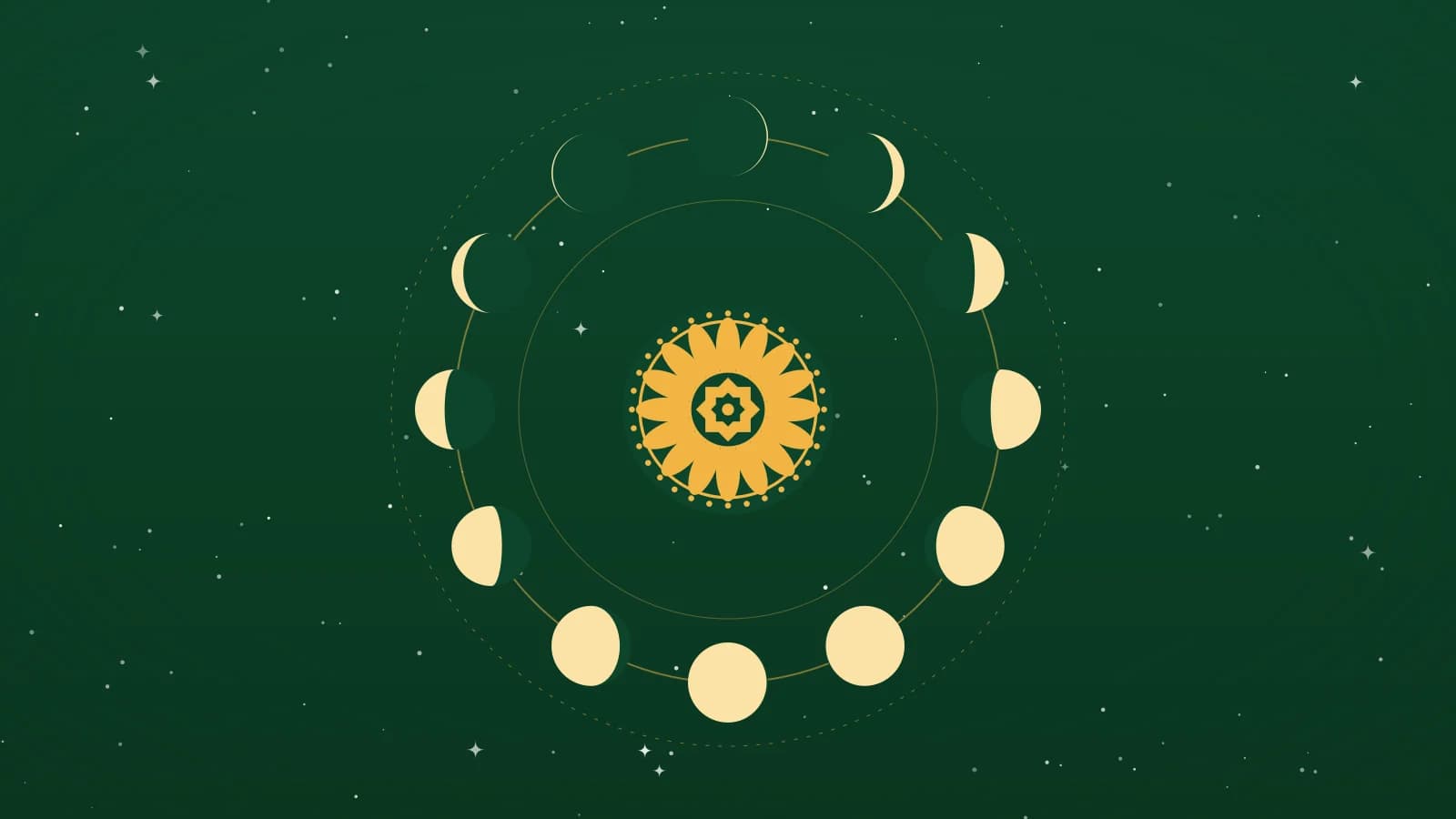
The Islamic calendar is purely lunar, so its months, including Ramadan, move about 11 days earlier each year against the solar calendar. The Jewish calendar is lunisolar, following the moon but adding a leap month to stay in step with the seasons. Most Christians use the solar Gregorian calendar, while many Orthodox churches keep the Julian calendar for religious dates.
Key Takeaways
- The Islamic (Hijri) calendar has twelve lunar months, as the Quran describes (At-Tawbah 9:36), and counts years from the Prophet's migration to Madinah in 622 CE.
- Because a lunar year is shorter than a solar one, Islamic dates move about 11 days earlier each year, so Ramadan passes through every season.
- The Jewish calendar is lunisolar, adding a leap month in some years so festivals stay in their seasons.
- The Gregorian calendar is solar and used by most Christians and for everyday civil dates, while many Orthodox churches use the Julian calendar for religious feasts.
- Islamic and Jewish days begin at sunset, while the Gregorian day begins at midnight.
The Three Calendars at a Glance
| Islamic (Hijri) | Jewish (Hebrew) | Christian (Gregorian) | |
|---|---|---|---|
| Type | Lunar | Lunisolar | Solar |
| Months | 12 lunar months | 12, with a 13th in leap years | 12 fixed-length months |
| Year length | About 354 or 355 days | Varies, with leap years longer | 365 days, 366 in leap years |
| Starting point | The Hijrah, 622 CE | Creation, according to Jewish tradition | The traditional year of the birth of Jesus |
| Day begins | At sunset | At sunset | At midnight |
| Festivals move? | Yes, about 11 days earlier each year | Stay within their seasons | Most are fixed; Easter moves |
The Islamic (Hijri) Calendar
Allah says: "Indeed, the number of months with Allah is twelve [lunar] months in the register of Allah [from] the day He created the heavens and the earth; of these, four are sacred" (At-Tawbah, 9:36, Sahih International). Each month begins with the sighting of the new crescent: "They ask you, [O Muhammad], about the crescent moons. Say, 'They are measurements of time for the people and for hajj'" (Al-Baqarah, 2:189, Sahih International).
The Prophet named the four sacred months as Dhul-Qa'da, Dhul-Hijja, Al-Muharram and Rajab (Sahih al-Bukhari 4662). The calendar's years are counted from the Hijrah, the Prophet's migration from Makkah to Madinah in 622 CE, which is why Islamic years are marked AH. The first month, Muharram, holds significant days in Islamic history, including the day remembered in our article on the sacrifice of Imam Hussain.
Why Ramadan Moves Through the Seasons
A lunar year is roughly 11 days shorter than a solar year. With no leap month to correct it, Islamic dates move about 11 days earlier in the Gregorian calendar each year. Over a lifetime, Ramadan falls in every season, with long summer fasts in some years and short winter days in others, a noticeable difference in the UK. The Quran describes the sun and moon as given "that you may know the number of years and account [of time]" (Yunus, 10:5, Sahih International).
The Jewish (Hebrew) Calendar
The Jewish calendar is lunisolar. Its months follow the moon, but an extra month is added in certain years, on a 19-year cycle, so that festivals like Passover stay in their proper seasons. Its years are counted from creation according to Jewish tradition, and its new year, Rosh Hashanah, falls in the autumn. Like the Islamic calendar, each day begins at sunset.
The Christian Calendars
Most Western Christians, and most of the world for civil purposes, use the Gregorian calendar, a solar calendar introduced in 1582 to correct drift in the older Julian calendar. Many Orthodox churches still follow the Julian calendar for religious feasts, which is why Orthodox Christmas is often celebrated in January. Most Christian festivals fall on fixed dates, while Easter moves each year according to a calculation linked to the moon and the spring equinox.
Why This Matters for Muslims in the UK
- Planning ahead. Ramadan and Eid move earlier each year, affecting school, work and holiday plans.
- Moon sighting. The start of Islamic months depends on the new moon, and communities sometimes differ on method, so dates can vary slightly between mosques.
- Understanding neighbours. Knowing how other faiths' calendars work builds understanding with Jewish and Christian friends and colleagues.
Learn More About Islamic History and Practice
Our Islamic Studies course covers the Hijri calendar, the sacred months and Islamic history one-to-one, and our Tafseer course explores the verses on time and the moon in depth. New Muslims can start with our Quran for reverts lessons. You can book a free trial lesson with no card required.
Frequently Asked Questions
Start with a Free Trial, No Card Needed
Meet your teacher in a real, live lesson and see how it feels, with no commitment either way. Or WhatsApp us on +44 7848 496686 with any questions first.